Learn how to teach art in your homeschool—even if you’re not an artist—with practical tips for supplies, art skills, scheduling, and creativity.
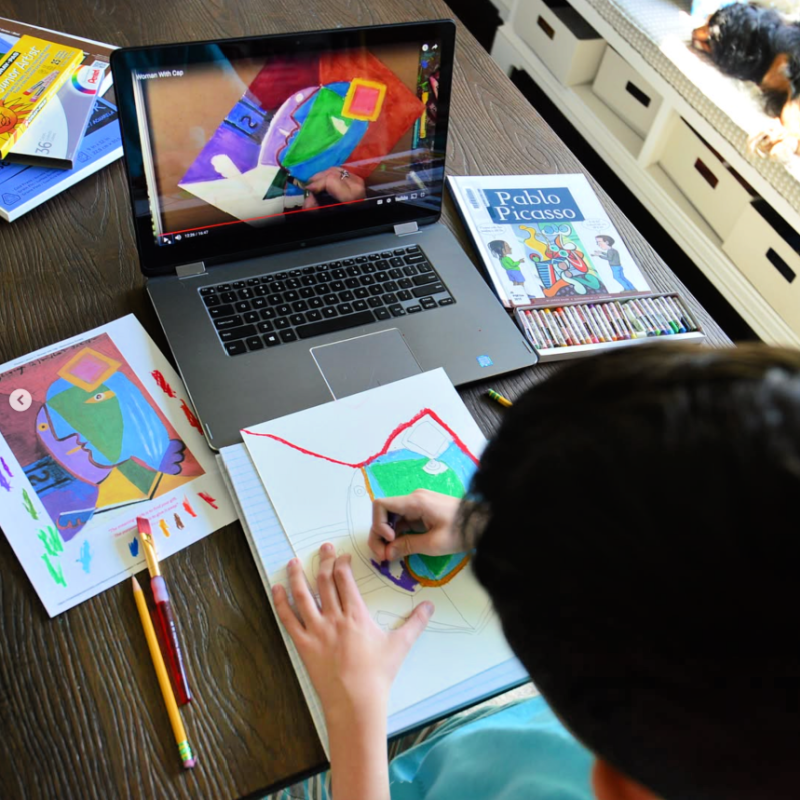
You want your children to have art in their homeschool. You love the idea of sketchbooks scattered across the table, watercolor paintings drying by the window, afternoons spent learning about Monet, Van Gogh, or Picasso, and children who grow up feeling comfortable and confident creating.
There's just one problem. You don't know how to teach art.
Maybe you haven't taken an art class since middle school. Maybe you don't know the difference between oil pastels and crayons. Maybe the thought of teaching perspective or color theory makes you want to quietly put the art supplies back in the closet and pull out another math worksheet instead.
I understand. But here's the good news: You don't have to be an artist to give your children a rich art education.
You don't even have to know very much about art when you begin. You simply need to understand what a good art education includes, establish a realistic rhythm for your family, gather a few basic supplies, and give your children plenty of opportunities to look at great art and make art of their own.
Let's walk through exactly how to do that.
What Does a Good Homeschool Art Education Include?
Before choosing curriculum or buying supplies, it helps to step back and ask what we're actually trying to accomplish.
A rich art education is about much more than completing a certain number of projects each school year. Ideally, children should have opportunities to:
- create art regularly
- explore a variety of art materials
- develop foundational drawing and painting skills
- experiment and solve creative problems
- learn the elements and principles of art
- encounter beautiful and important works of art
- become familiar with artists and artistic movements
- learn to observe the world more carefully
- express their own ideas visually
- develop confidence through practice
You don't have to accomplish all of these things every week. And you certainly don't need to teach them all at once.
Think of art education as something you're building gradually over many years. Your six-year-old doesn't need to master perspective. Your ten-year-old doesn't need to understand every principle of composition. Your fourteen-year-old doesn't need to have discovered a personal artistic style.
Give them time. Art education is a long game.
1. Decide What Art Will Look Like in Your Homeschool

One of the wonderful things about homeschooling is that art doesn't have to look like a traditional school art class. You have options.
A weekly subject. Every Thursday afternoon, you pull out the art supplies and complete a lesson. Or, many of our Studio members prefer to have "Fine Arts Fridays." The day of the week is entirely up to you and your family.
A block subject. You spend several weeks concentrating on watercolor, drawing, or a particular artist before moving on to something else.
Part of Morning Time. You look at a work of art together, read about an artist, or occasionally add a simple art activity.
Connected to other subjects. Art can complement history, literature, geography, nature study, or even mathematics.
An independent subject for older students. Middle and high school students can increasingly work through online art courses on their own.
You can also combine several of these approaches. The important thing is to choose something that actually fits your family. The most elaborate homeschool art plan in the world isn't helpful if you're never able to do it.
2. Choose a Realistic Art Rhythm
For many homeschool families, one intentional art lesson each week is enough to create a wonderful foundation. That's roughly 36 art lessons over a traditional school year.
You could designate Friday afternoon as your art time. Or Tuesday after lunch. Or every other Wednesday for a longer studio afternoon. Your schedule might look completely different. The point isn't the particular day or number of minutes. It's giving art a place on the calendar. Because here's what tends to happen when we say, "We'll get to art when we have time."
We don't.
Math takes longer than expected. Someone needs help with writing. There's an appointment. The laundry has apparently reproduced overnight. And suddenly it's May and we're still planning to get around to that watercolor lesson.
If art matters to your family, give it a regular place in your homeschool rhythm. It doesn't have to be rigid. It simply needs to exist.
3. Create a Simple Place to Make Art
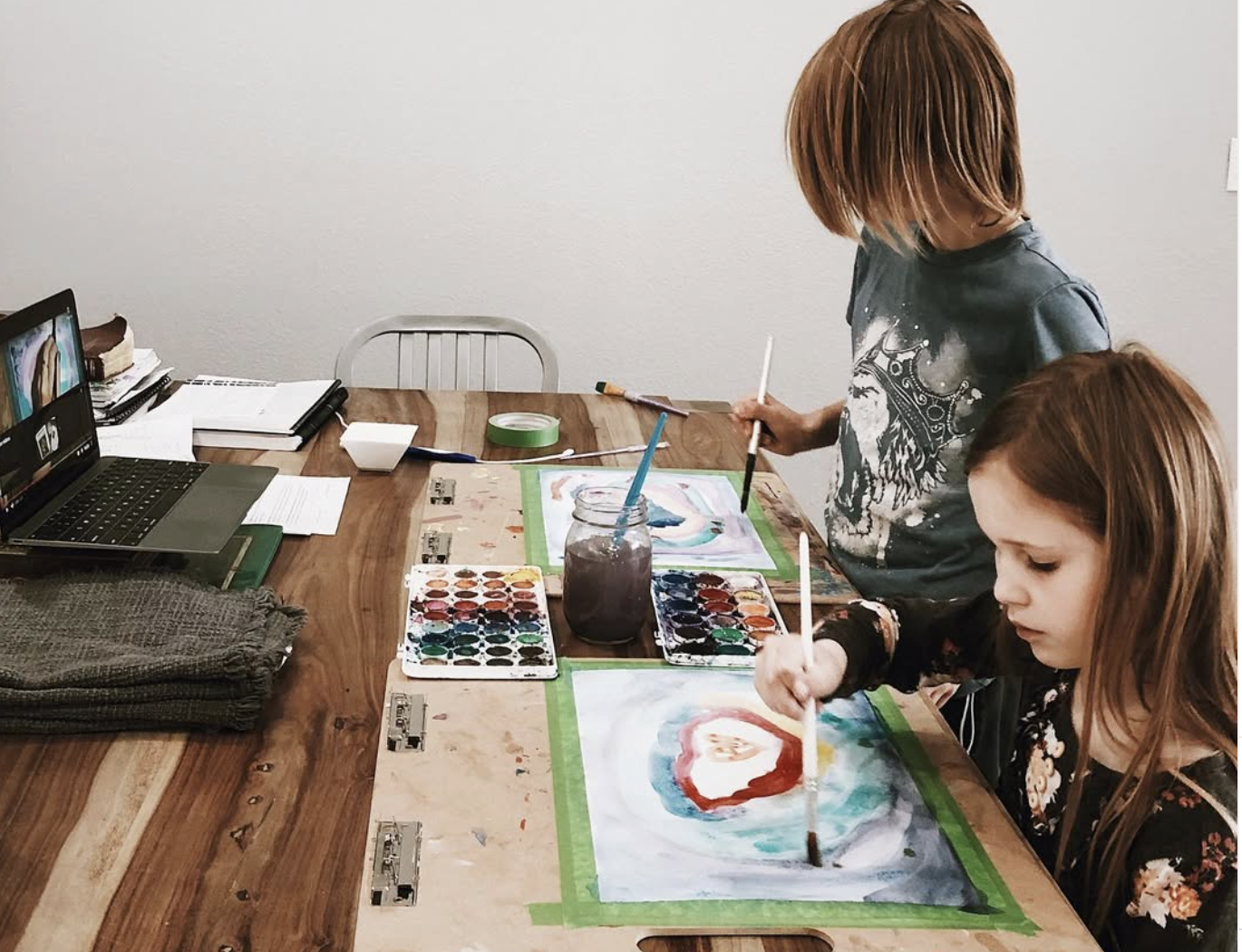
You don't need a dedicated art studio. You don't need beautiful shelving filled with perfectly organized jars of paintbrushes. You need a surface where children can work and a place where supplies can live.
For many families, that's simply the kitchen or dining room table. Keep frequently used supplies somewhere reasonably accessible—a rolling art cart, cabinet, shelf, basket, or set of drawers. You might also keep a few inexpensive table coverings nearby so that pulling out the paint doesn't require a major furniture-protection operation. The easier it is to begin, the more likely you are to actually make art.
If preparing for an art lesson takes 30 minutes, art will always feel like an event. If you can pull out paper, paints, brushes, and water in five minutes, it becomes part of normal homeschool life.
4. Start With a Basic Collection of Art Supplies
You don't need to buy everything at once. In fact, please don't.
A thoughtfully chosen collection of versatile supplies will take you surprisingly far. I recommend gradually building a collection that includes:
- drawing, mixed-media, or watercolor paper
- pencil and kneaded eraser
- a basic watercolor set
- acrylic craft paints (you can upgrade to student grade later)
- a simple paintbrush set (can be used for both watercolor and acrylics)
- soft and/or oil pastels
- black Sharpie or permanent pen
- scissors
- glue
Then add specialty materials as your curriculum requires them.
There is, however, one place where quality matters more than parents sometimes realize: paper.
Trying to learn watercolor on thin printer paper is an exercise in frustration. Children don't need professional artist-grade materials, but they do need supplies that are capable of doing what they're asking them to do. Watercolor paper should be 140 lbs so that it doesn't buckle, wrinkle, or rip.
A few decent supplies are better than a huge collection of poor-quality ones. If you want to see the ones we use on a regular basis in our Masterpiece Society art courses, click here.
5. Teach Children How to Use Their Art Materials
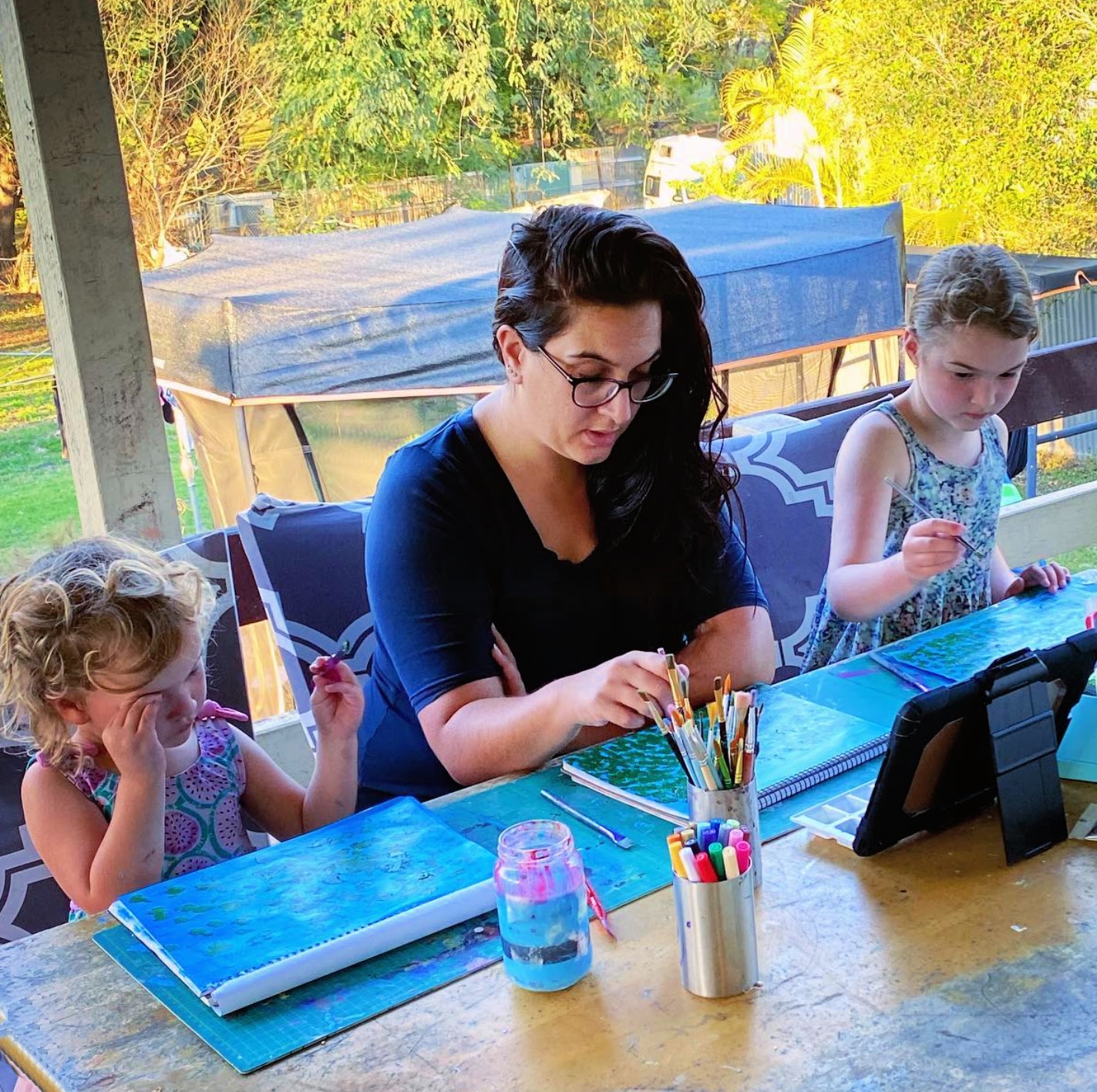
Before expecting children to create beautiful paintings, teach them what their materials can do.
How much water should go on a watercolor brush? What happens when you mix two colors? What's the difference between pressing hard and lightly with a pencil? How can oil pastels be layered? What happens when acrylic paint is applied with a dry brush instead of a wet one? How do you clean a brush properly? How should chalk pastels be handled?
These may seem like tiny things, but they remove enormous amounts of frustration.
Sometimes a child thinks, "I'm bad at painting." When the real problem is, "No one ever showed me how this paint works."
Give children time to experiment with materials before expecting a finished product. Make color charts. Practice brushstrokes. Mix colors. Blend pastels. Create different kinds of lines. Experiment with watercolor washes.
Learning the tools is part of learning art.
6. Teach Art Skills Gradually
You don't need to sit down and formally teach the entire "Elements of Art" chart to your seven-year-old. Children can learn artistic concepts naturally as they create. Over the years, introduce ideas such as:
- Line — thick, thin, straight, curved, broken, expressive.
- Shape — geometric and organic shapes and how artists use them.
- Color — primary and secondary colors, warm and cool colors, complementary colors, tints, shades, and color mixing.
- Texture — both actual texture and the illusion of texture.
- Value — light and dark and how value creates dimension.
- Form — how flat shapes begin to look three-dimensional.
- Space — foreground, middle ground, background, overlapping, scale, and eventually perspective.
As students grow older, they can begin thinking more intentionally about proportion, perspective, composition, balance, contrast, emphasis, movement, rhythm, unity, color theory, and light and shadow.
You don't need to teach these concepts in isolation. It's often more effective to introduce them while students are actually using them.
7. Teach Children to Draw What They See
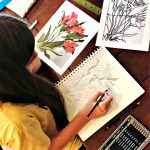
One of the most valuable skills you can help children develop is observation. Young children often draw what they know rather than what they actually see. They know a flower has petals, so they create a familiar flower symbol. They know an eye is shaped a certain way, so they draw their idea of an eye rather than carefully observing the eye in front of them.
That's perfectly normal. But as children mature, we can gently teach them to slow down and look.
What shape is it really? Where does that line curve? Which part is larger? Where is the darkest area? Where is the light coming from? What colors do you see besides the obvious one?
Drawing teaches children to pay attention. And observation strengthens nearly everything else they'll eventually do in art.
8. Let Children Make Lots of Art
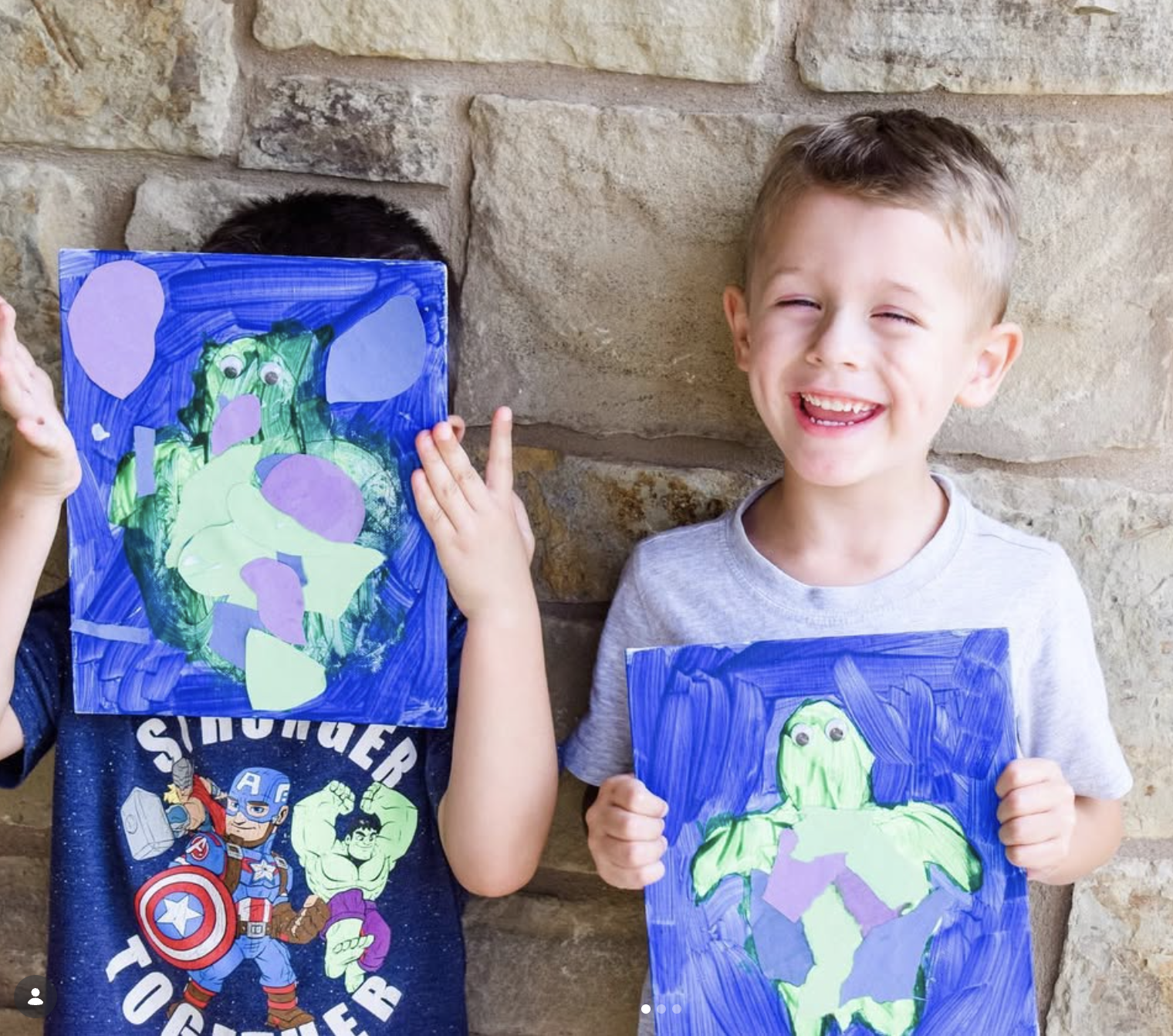
This sounds obvious, but it's surprisingly easy to turn art education into learning about art rather than actually making it. Children need to make things. Lots of things. Some will be beautiful. Some will be strange. Some will work exactly as they hoped. Some absolutely will not. That's part of the process.
Every art project doesn't need to be worthy of framing. Children need low-pressure opportunities to sketch, experiment, mix colors, try unfamiliar materials, abandon ideas, begin again, and discover things accidentally. The more they create, the more comfortable they become with the creative process. Skill grows through making.
9. Don't Take Over Your Child's Artwork
This one can be difficult. You see exactly what's wrong. That eye needs to move over. That tree needs another branch. That color would look better over there. And wouldn't the painting look so much nicer if you just fixed that one little part? Resist.
Our job is to teach the skill without taking ownership of the artwork. Demonstrate on your own paper. Ask questions. Show them a technique. Help them observe more carefully. But whenever possible, let your child make the artistic decision.
Their artwork doesn't need to look like yours. It doesn't even need to look like the teacher's example. The goal is not to produce a collection of identical projects. The goal is to develop artists who know how to think and create for themselves.
10. Don't Correct Every Creative Choice
There's an important difference between teaching a skill and correcting an artistic choice. If you're teaching proportion, you can help a student observe proportion more accurately. If you're teaching watercolor, you can demonstrate how to control the amount of water on the brush.
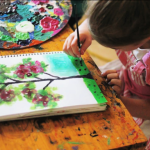
But if your child wants a turquoise tree? That may simply be an artistic choice. Children need room to experiment with color, composition, materials, style, and ideas. Technique gives them tools. Creativity gives them permission to decide what to do with those tools.
We want both.
11. Include Art Appreciation
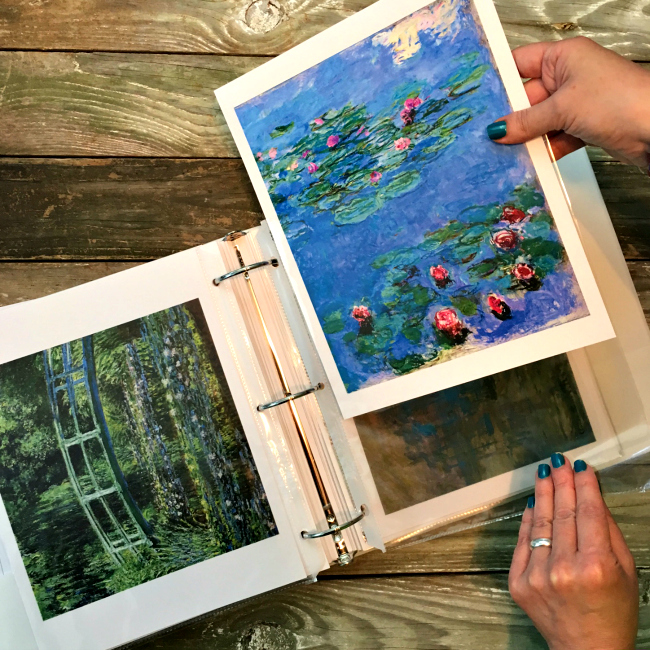
Making art is only one part of a rich art education. Children should also spend time looking at art. And this doesn't have to become a complicated art history course.
Choose a painting. Put it somewhere everyone can see it. Look at it together. Ask simple questions: What do you notice first? What colors do you see? Where do you think the light is coming from? What do you think is happening? What details do you notice? How does the painting make you feel? What do you think the artist wanted us to notice?
You don't always need to explain the painting immediately. Give children time to look first. Observation before explanation can lead to wonderful conversations.
If you'd like to make art appreciation a more intentional part of your homeschool, read my Homeschool Art Appreciation Guide.
12. Introduce Your Children to Great Artists
Over time, let your children become familiar with artists from different periods, cultures, styles, and movements.
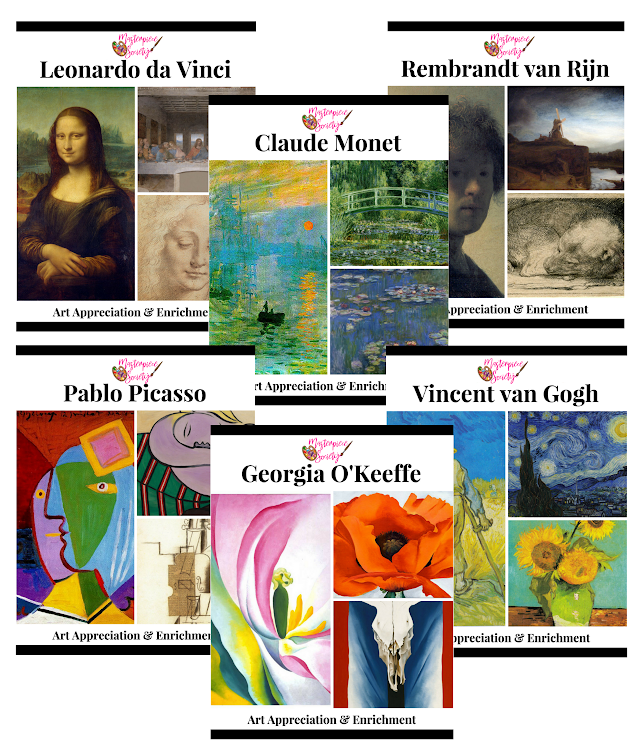
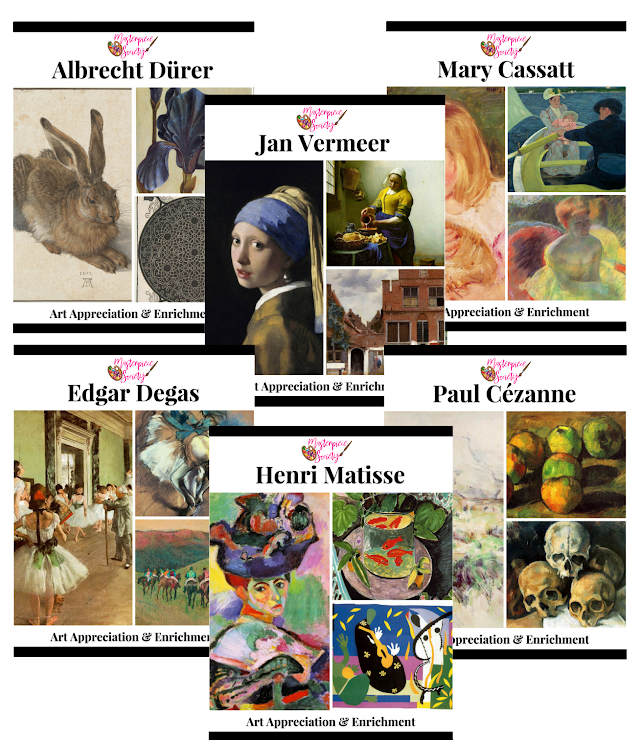
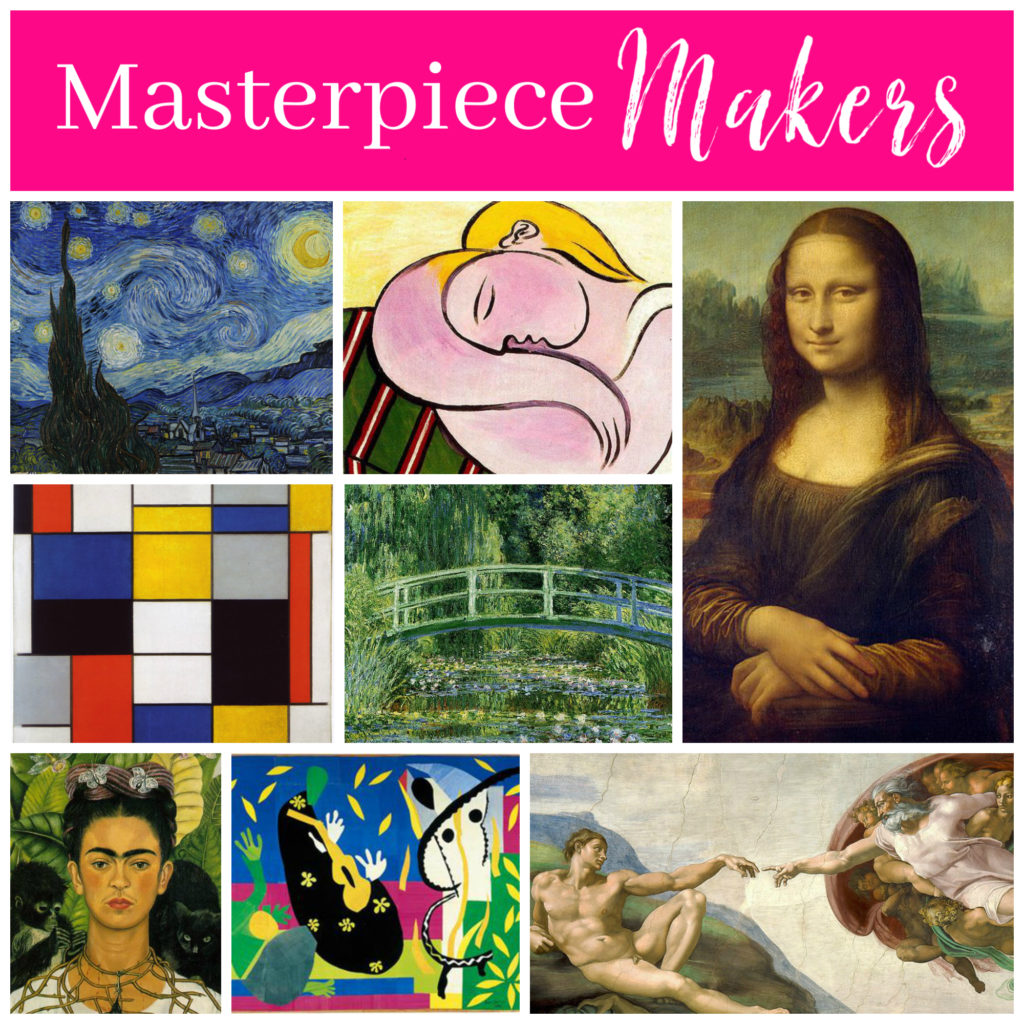
Monet. Van Gogh. Rembrandt. Vermeer. Matisse. Kandinsky. Klee. O'Keeffe. And many, many more.
Learn a little about their lives. Look at several pieces of their artwork. Notice recurring subjects, colors, techniques, or styles. Talk about what made their work distinctive. Then, when appropriate, let your children experiment with an artistic idea inspired by what they've discovered.
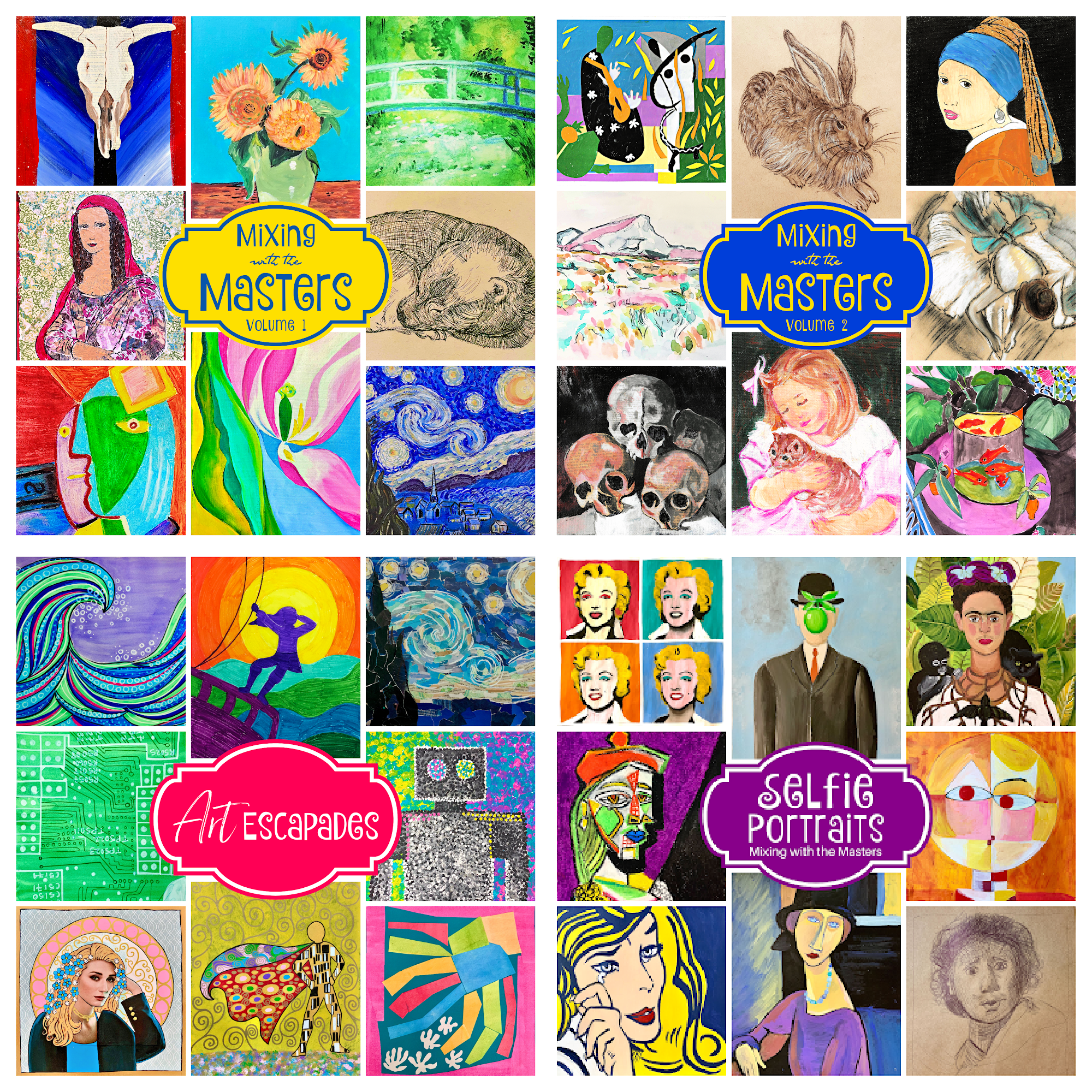
The goal isn't to create a miniature Monet. It's to ask: What can we learn from this artist? That's the philosophy behind our Mixing with the Masters courses, where children encounter great artists and then put some of those discoveries into practice through their own artwork.
13. Connect Art With Other Homeschool Subjects
Art doesn't need to live in its own little box. In fact, some of the richest homeschool experiences happen when subjects overlap.
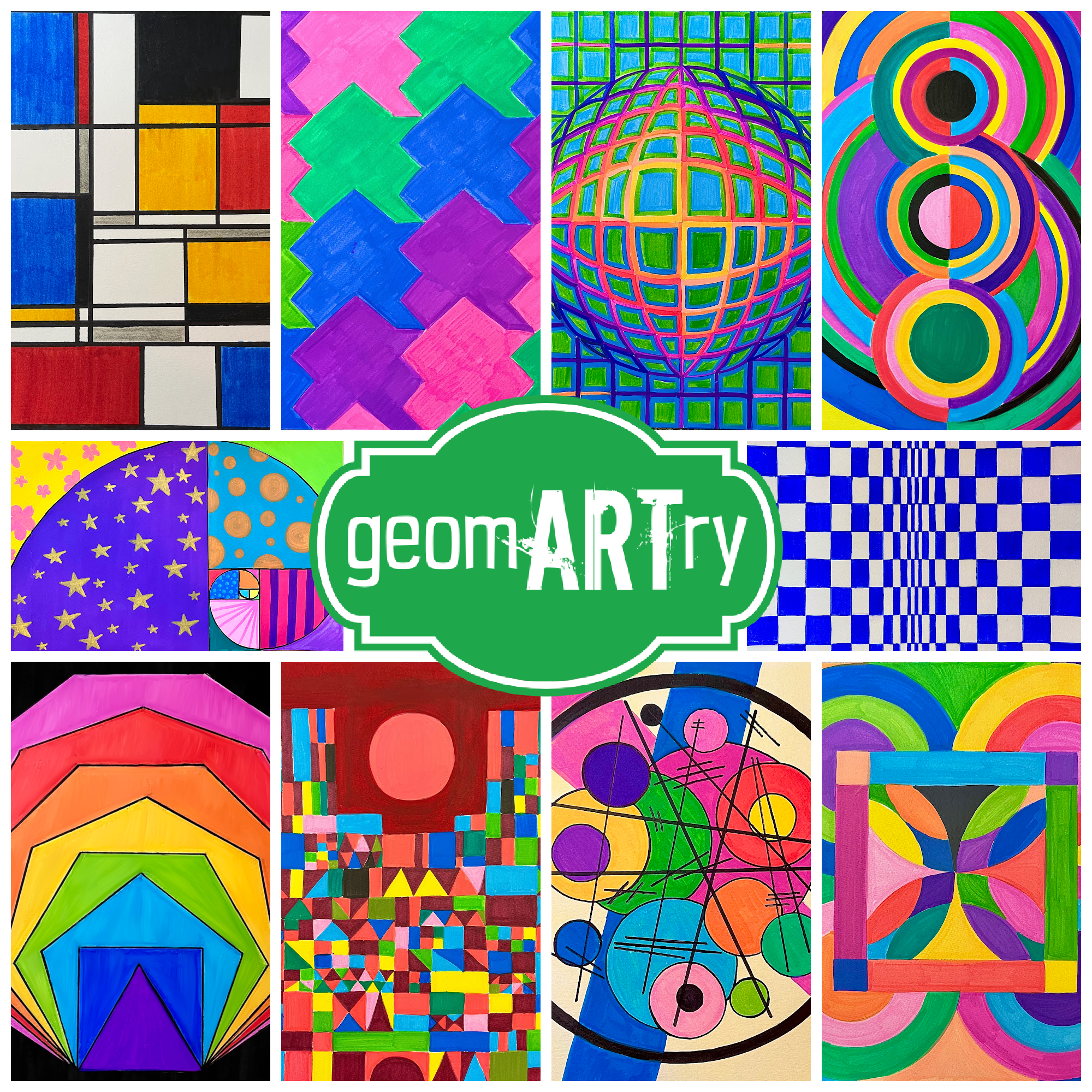
Studying ancient Egypt? Look at Egyptian art and architecture. Reading a wonderful novel? Create art inspired by the story. Studying geometry? Explore artists who use shape, symmetry, pattern, perspective, and optical effects. Learning about the Renaissance? Meet Leonardo, Michelangelo, and Raphael. Studying birds or flowers? Sketch what you observe. Learning about another country? Explore its art, architecture, textiles, pottery, or other visual traditions.
This is one of the reasons art works so beautifully in a homeschool environment. You have the freedom to make those connections.
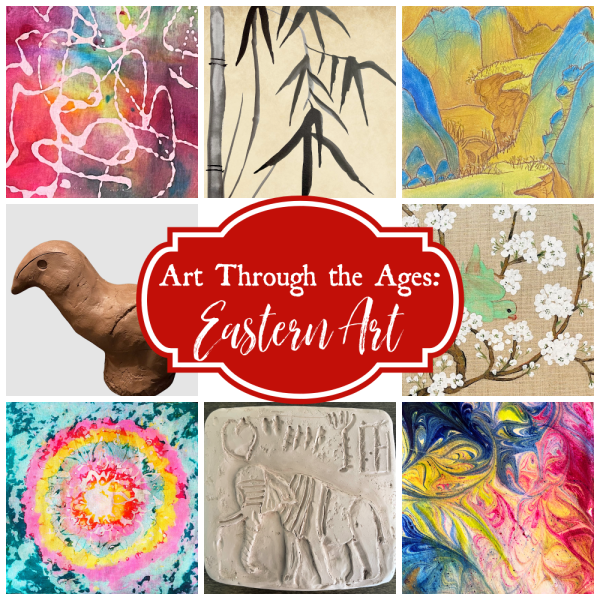
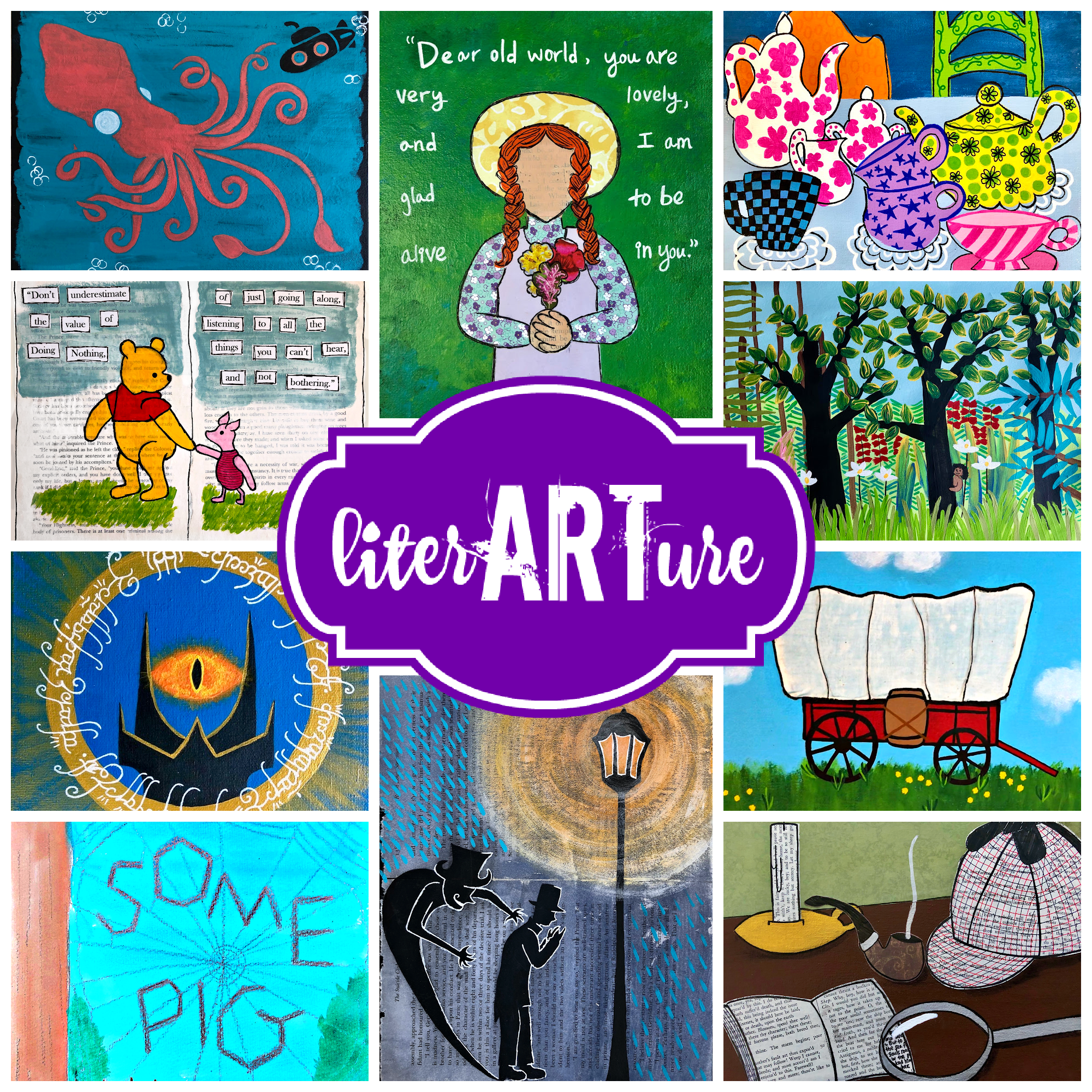
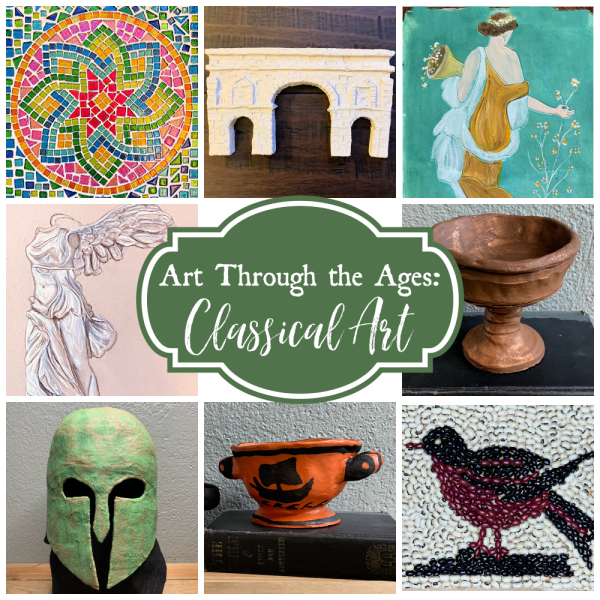
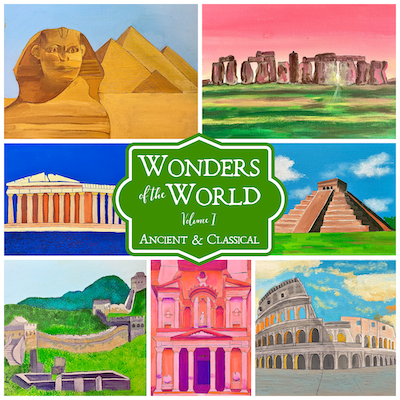
Our LiterARTure, Art Through the Ages, Wonders of the World, GeomARTry, and other courses were created around many of these same interdisciplinary connections.
14. Adjust Art Instruction as Your Children Grow
Art education shouldn't look exactly the same at six, eleven, and sixteen.
Early Elementary
Focus heavily on exploration. Let children paint, draw, cut, glue, layer, mix, print, build, and experiment with a variety of materials. Introduce foundational concepts gently through hands-on projects.
If you're teaching younger children, my Elementary Homeschool Art Curriculum Guide goes into much more detail about what art can look like during these years.
Upper Elementary and Middle School
Continue giving students variety, but begin developing skills more intentionally. Children can handle more detailed drawing, painting techniques, artist studies, art history, composition, color theory, and longer projects.
This is also a wonderful age to notice what your child gravitates toward.
Teens and High School
Now students are ready for more focused skill development. They can study drawing, perspective, value, color theory, watercolor, acrylics, oils, pastels, composition, and other techniques in greater depth.
They can also explore art history, architecture, nature journaling, abstraction, and interdisciplinary art studies.
My Art Curriculum for Teens & High School Homeschoolers guide explains how you can build a rich high school art education around those different areas.
15. Let Their Interests Help Guide You
Pay attention to what keeps pulling your children back. One child may fill sketchbooks with characters. Another wants to paint everything. Another loves detailed realistic drawings. Another is fascinated by architecture. One might love Monet. Another thinks abstract art is the most interesting thing they've ever seen.
Those interests matter.
You don't have to abandon foundational skills in favor of whatever your child happens to feel like doing that day. But interest is a powerful teacher. Use it.
Once children have a foundation, give them opportunities to go deeper into the mediums, subjects, artists, and styles they love. That's one of the great advantages of homeschooling. Their art education can actually belong to them.
16. Don't Compare Your Child's Art
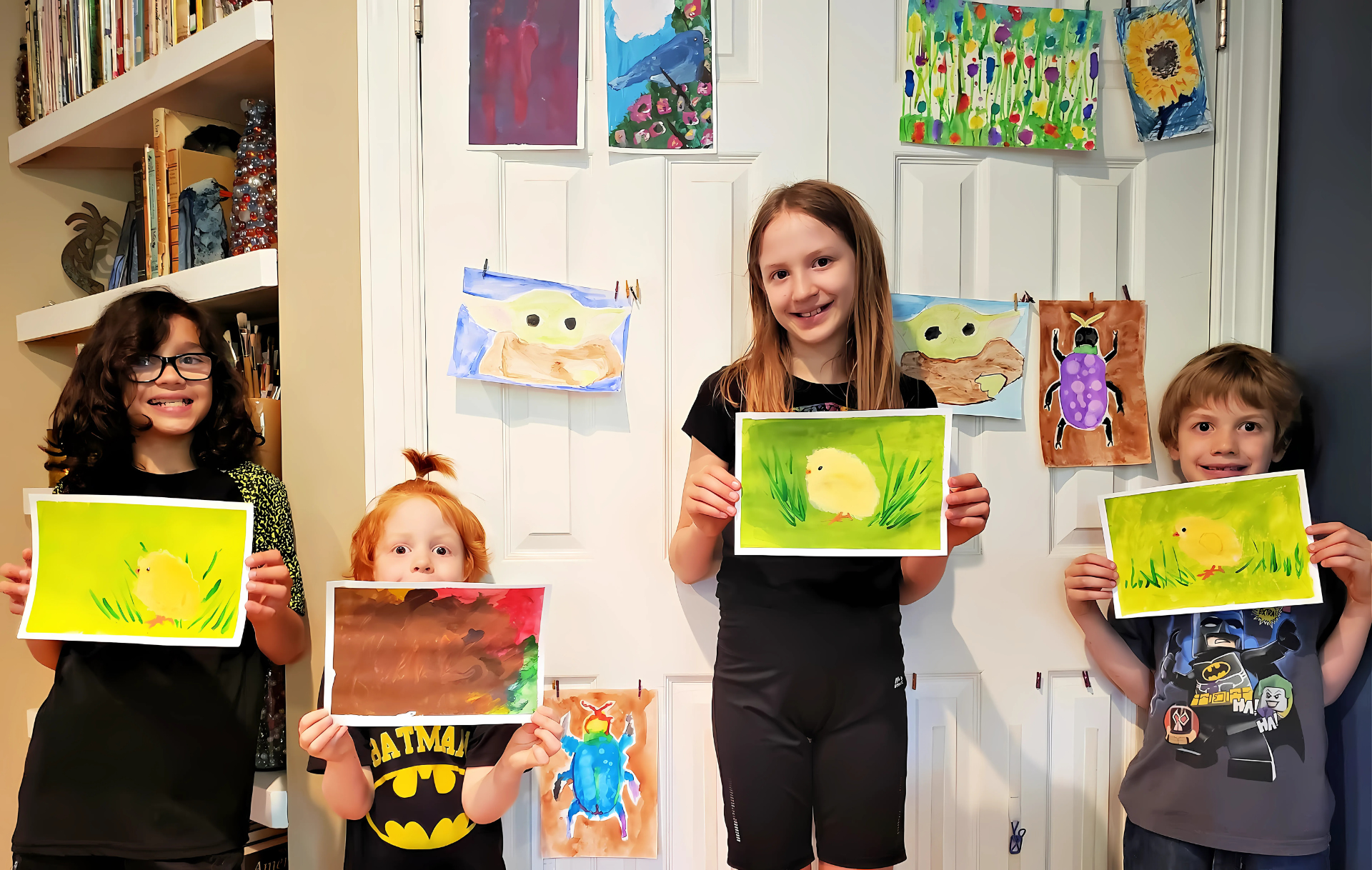
This is especially important as children get older.
Some children develop fine-motor skills earlier. Some have spent far more time drawing. Some naturally notice proportion. Some understand color intuitively. Others need much more practice.
And in an online world, children can compare their beginning work not only to a classmate's work but to the work of incredibly accomplished artists.
Help them compare their work to their own previous work instead.
What can you do now that you couldn't do six months ago? What have you learned? What feels easier? What would you like to improve next?
Artistic growth isn't a race.
17. Keep Their Artwork
You certainly don't need to keep every piece of paper your child has ever touched with a crayon. But do save some of it.
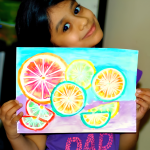
Choose representative pieces throughout the year. Date them. Photograph oversized or three-dimensional projects. Keep a portfolio. For younger children, it becomes a wonderful record of their creative development. For older students, it can document homeschool coursework. And for teens who become serious about art, keeping strong finished pieces may eventually help them begin building an art portfolio.
There's something incredibly encouraging about looking back and realizing: "I couldn't do that a year ago."
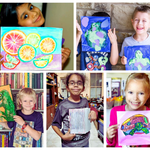
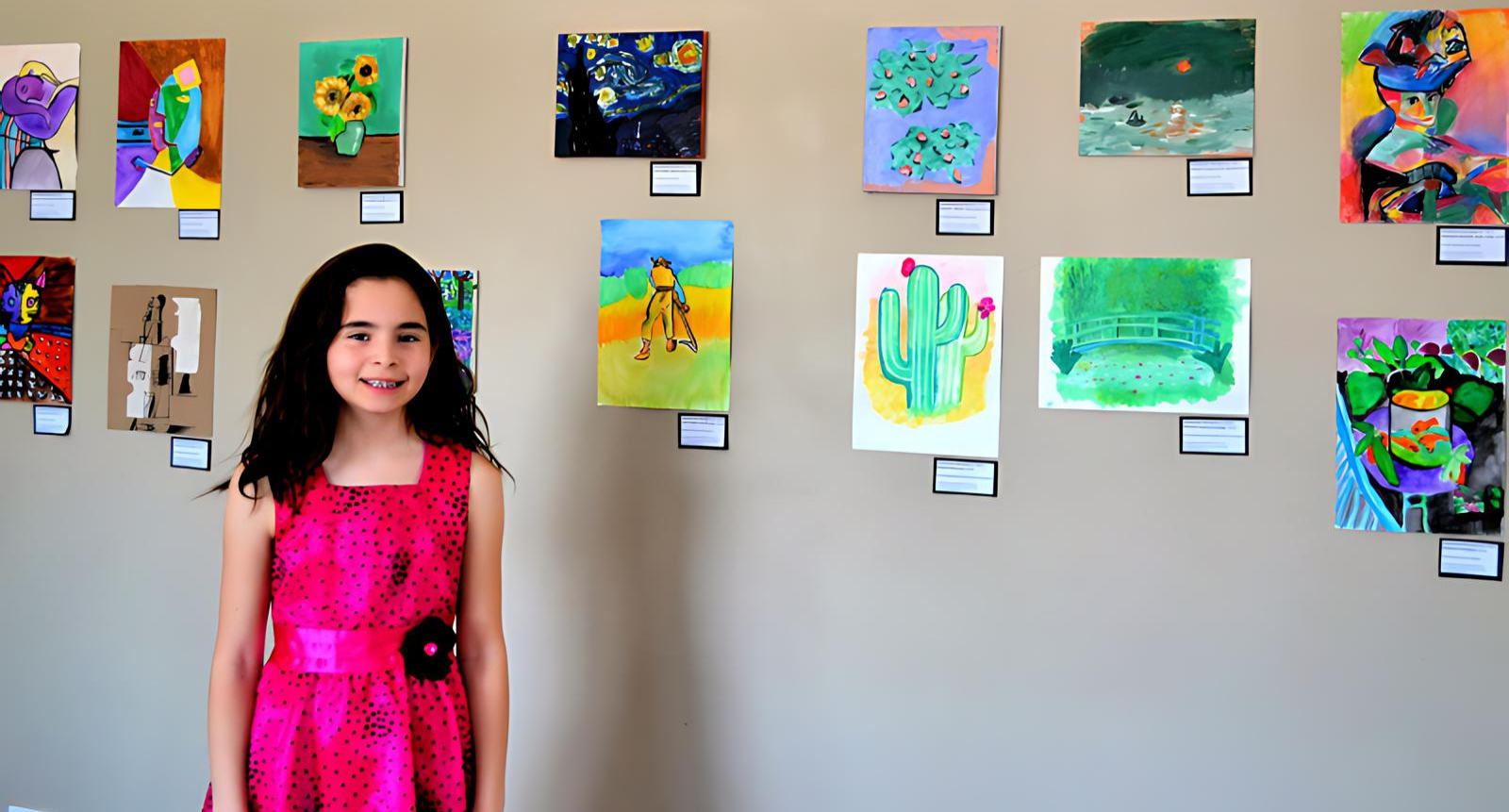
A fun thing to do each year (or every other year) is host an art exhibition for your children, inviting family and friends over to admire their work.
18. Remember That You Don't Have to Teach Everything Yourself
This may be the most freeing part.
Being responsible for your child's education doesn't mean you personally have to be the expert in every subject. You can bring wonderful teachers into your homeschool.
That's especially helpful with art because so much of art instruction is visual. Children benefit enormously from actually watching someone mix a color, shade a sphere, create a watercolor wash, blend a pastel, hold a brush, develop a drawing, or work through a mistake.
Video instruction allows children to see the process—and pause, rewind, and watch again whenever they need to.
And it allows you to stop worrying about whether you're teaching the technique correctly.
So...What If I Still Don't Want to Teach Art?
Maybe you've read this entire guide and you're thinking: This sounds wonderful.
Followed immediately by: I still don't want to plan all of it myself.
That's okay. In fact, that's exactly why I created Masterpiece Society.
I've spent years developing homeschool art lessons so you don't have to spend your evenings searching for projects, figuring out which supplies you need, teaching yourself a technique, and then trying to teach it to your children the next morning.
We can teach the art. You can simply make room for it.
Masterpiece Society includes art instruction for children from young elementary artists through teens, with opportunities to explore:
- drawing
- watercolor
- acrylics and oils
- pastels
- mixed media
- sculpture
- mosaics
- famous artists
- art appreciation and art history
- literature-inspired art
- architecture
- seasonal art
- modern and abstract art
- and much more!
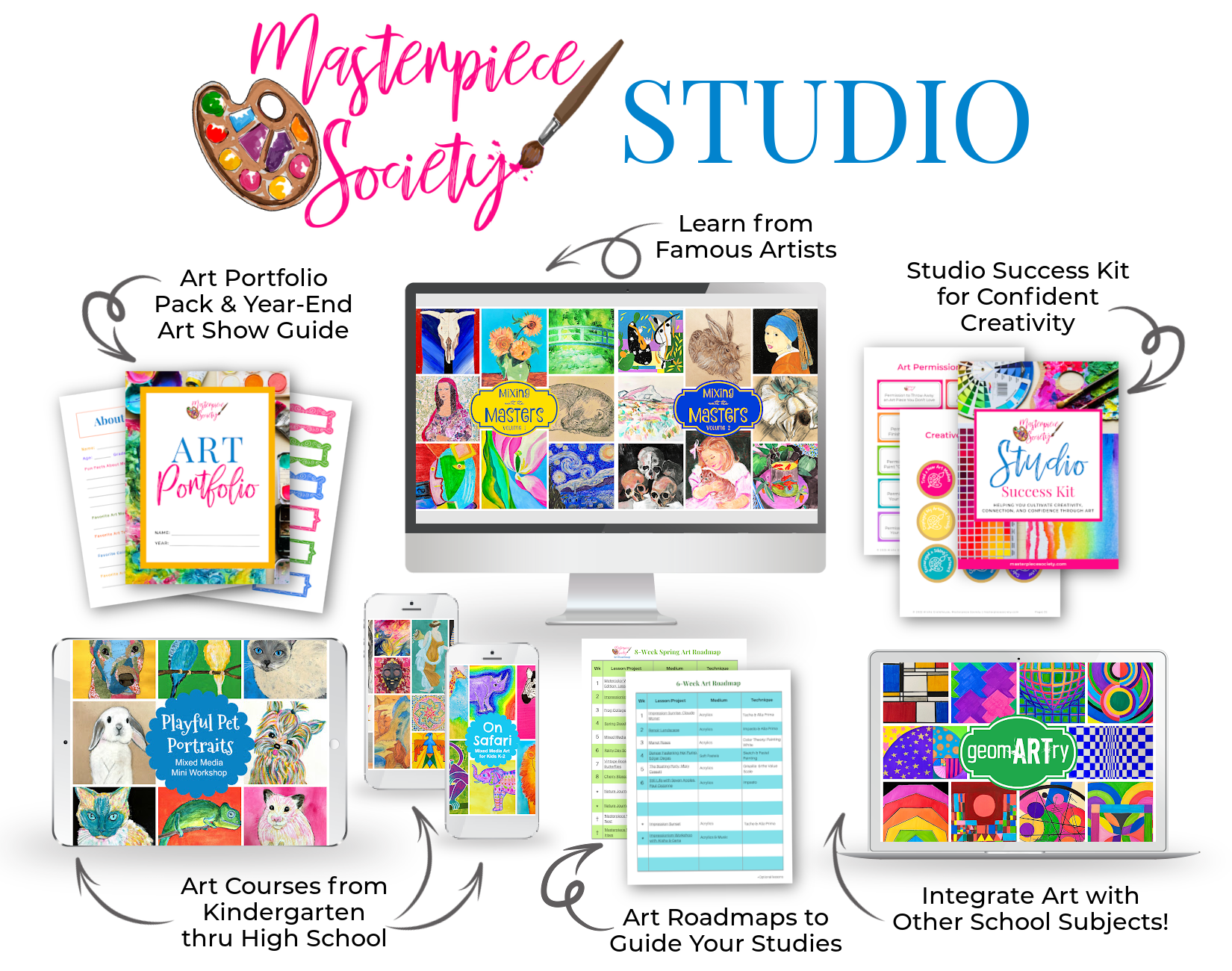
If you want the greatest variety and the ability to follow your children's interests over time, Masterpiece Society Studio gives your family access to our larger library of homeschool art instruction.
👉 Explore Masterpiece Society Studio
Or Start With One Simple Year of Art
If joining a large art library feels like more than you need right now, there's another option.
The Artful Year gives you a simple, ready-made path through the school year: 36 art lessons for 36 weeks.
You don't need to decide what to teach next. You don't need to build a curriculum. You simply follow the plan and make art together.
It's a wonderful place to begin if what you really want is: "Just give me one good art lesson each week."

A Simple Homeschool Art Plan You Can Start This Week
If all of this still feels like a lot, forget the perfect art curriculum for a moment.
Start here:
Choose one day each week for art. Gather a small collection of good-quality basic supplies. Spend some weeks making art and occasional weeks looking at and learning about great art. Introduce new materials and techniques gradually. Let your children experiment. Teach skills without taking over their artwork. Notice what interests them. As they grow, gradually deepen their instruction.
That's enough. You can build from there.
You Can Give Your Children a Rich Art Education
You don't have to know how to draw beautifully. You don't need an art degree. You don't need a dedicated studio. You don't need an enormous collection of supplies. And you don't need to recreate a school art classroom at home.
What your children need is much simpler: beautiful things to look at, good materials to work with, skills they can develop, freedom to experiment, time to practice, and encouragement to keep creating.
Give them those things consistently over the years, and you'll have given them something far more valuable than a collection of finished art projects.
You'll have helped them learn to observe, imagine, experiment, solve problems, make decisions, and create.
And that is a rich art education.
Frequently Asked Questions About Teaching Art in Your Homeschool
Do I need to be an artist to teach homeschool art?
No. Parents can provide a rich art education without being trained artists themselves. You can provide the materials, schedule, encouragement, and opportunities while using books, curriculum, online lessons, museums, and other resources for instruction.
How often should we do art in our homeschool?
For many families, one intentional art lesson each week is a realistic and effective rhythm. Children who are particularly interested in art may want to create much more frequently.
What should I teach first in homeschool art?
For younger children, begin with exploration of basic materials and concepts such as line, shape, color, and texture. As children mature, gradually introduce observation, drawing, value, form, composition, perspective, color theory, and more advanced techniques.
What art supplies do I need for homeschooling?
You can begin with drawing and mixed-media paper, pencils, colored pencils, watercolor, tempera or acrylic paint, brushes, oil or chalk pastels, markers, scissors, and glue. Add specialty materials as needed rather than buying everything at once.
Should homeschool art include art history?
Art history and art appreciation can add wonderful depth to a homeschool art education. Children benefit from encountering great works of art, learning about artists and artistic movements, and understanding some of the historical and cultural contexts in which art was created.
Can I teach several ages art together?
Yes. Art is one of the easiest homeschool subjects to enjoy together. Younger children can simplify a project while older students use more advanced techniques, add detail, or extend the assignment.
Can online art classes replace teaching art myself?
Online art instruction can provide the technical teaching and demonstrations, particularly when parents don't have an art background. Parents can then focus on providing supplies, scheduling time for art, encouraging practice, and enjoying their children's creative growth.
How do I teach art to a child who thinks they're not artistic?
Emphasize that artistic skills develop through instruction and practice. Avoid comparing their work with other children's artwork, provide achievable opportunities to build skills, and help them notice their own progress over time.
How do I teach art to a homeschooled teenager?
Teenagers are ready for more systematic instruction in drawing, value, proportion, perspective, composition, color theory, and specific art media. They can also pursue art history and specialized interests more independently. See my [Art Curriculum for Teens & High School Homeschoolers] guide for a more complete high school approach.